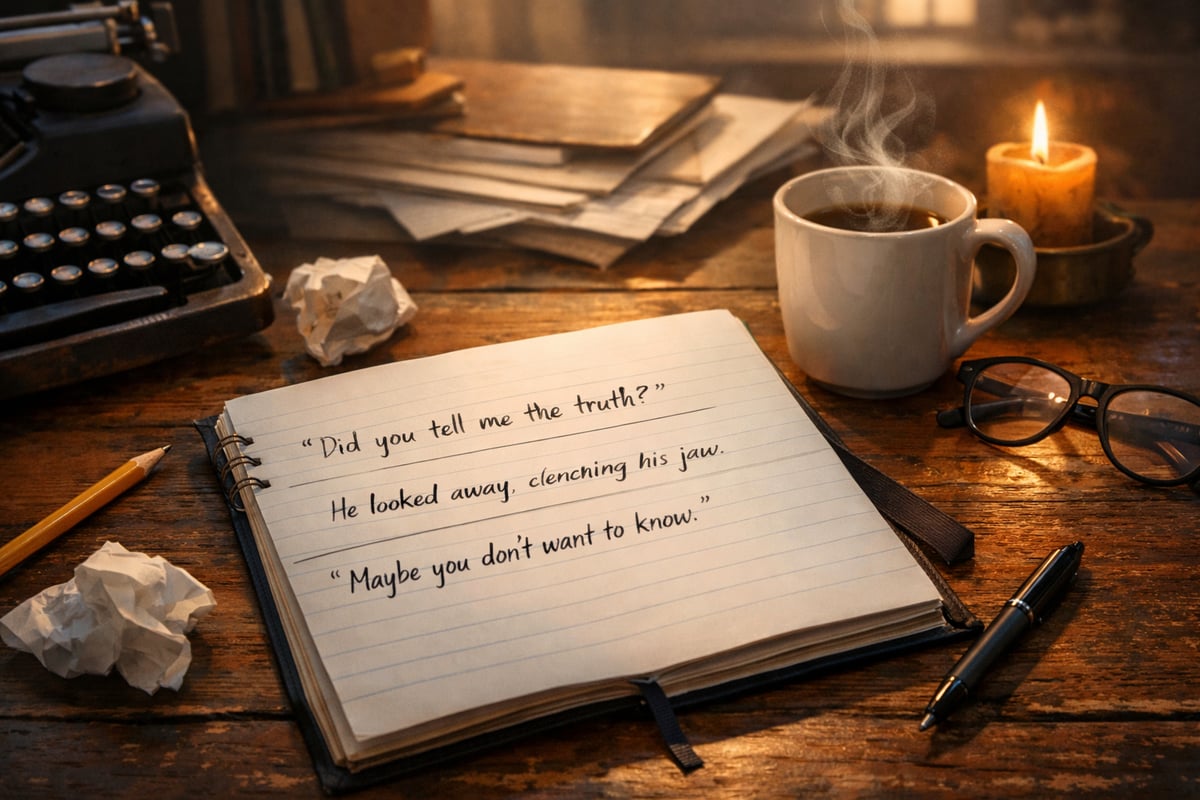
How to Write Dialogue That Doesn’t Sound Fake
Bad dialogue is one of the fastest ways to lose readers.
Good news: realistic dialogue is a skill you can learn—fast.
This guide is for indie beginner writers who want dialogue that feels natural, sharp, and alive. We’ll focus on subtext and action beats, the two biggest upgrades you can make today.
Why Dialogue Sounds Fake (Most of the Time)
Beginner dialogue usually fails because it is:
- Too on-the-nose
- Too polite
- Too explanatory
- Too perfect
Real people don’t speak in full explanations. They dodge, hint, interrupt, and hide what they really mean.
That’s where subtext and action beats come in.
1. Write What Characters Mean, Not What They Say
What Is Subtext?
Subtext = what’s really being communicated beneath the words.
People rarely say exactly what they feel.
Bad dialogue (no subtext):
“I’m angry that you lied to me.”
Better dialogue (with subtext):
“Is there anything else you forgot to tell me?”
Same emotion. More tension.
Tip:
Ask yourself after every line:
What is this character actually trying to get?
2. Cut Obvious Explanations
If dialogue explains what the reader already knows, cut it.
Bad dialogue:
“As you know, my brother, our father died ten years ago.”
Better:
“You still keep his watch?”
“I told you not to touch my things.”
Let the reader connect the dots.
3. Use Action Beats to Ground Dialogue
What Are Action Beats?
Action beats are small physical actions that break up dialogue and show emotion.
They:
- Replace dialogue tags
- Add realism
- Show feelings without stating them
Example:
“I’m fine,” she said.
vs.
“I’m fine.” She tightened her grip on the mug until her knuckles went white.
Same line. Very different meaning.
4. Don’t Overuse Dialogue Tags
You don’t need:
- exclaimed
- retorted
- growled
- sighed
Most of the time:
- Use said
- Or use an action beat instead
Example:
“You knew,” he said.
He stepped back, shaking his head.
Clean and clear.
5. Let Characters Talk Past Each Other
Real conversations are messy.
People:
- Avoid questions
- Change topics
- Answer the wrong thing
Example:
“Did you take the money?”
“You always think the worst of me.”
Instant conflict. No explanation needed.
6. Read Dialogue Out Loud (Non-Negotiable)
If it sounds weird when spoken, it is weird on the page.
When reading out loud, listen for:
- Lines that are too long
- Perfect grammar
- Repeated names
Cut or shorten anything that doesn’t sound human.
7. One Powerful Exercise (Do This Today)
Take a dialogue scene you’ve written and:
- Remove all emotions stated directly
- Remove all adverbs
- Add one action beat per character
You’ll be shocked how much stronger it gets.
Final Rule to Remember
Great dialogue isn’t about sounding clever.
It’s about hiding the truth and letting the reader feel it.
Master subtext and action beats, and your dialogue will stop sounding fake—fast.
If you want help rewriting dialogue scenes or practicing subtext, tools like Storiando can guide you line by line while you write.