How to Turn Story Notes Into a Plot
You have notes about a character, a place, and a few things that might happen. Maybe you can picture the garden where your story starts, or you’ve written down a line of dialogue you want to use. How do those ideas become a plot?
Start with two or three notes and one character. A plot is a chain of events connected by what your character does and what happens as a result. Three questions can help you build that chain. What does your character want? What gets in the way? What changes next?
Start with what your character wants
Pick one character from your notes and ask what they want right now. It might be something small and specific, like finding a missing key, making a friend, or keeping a promise. A goal gives you a way to decide which notes belong at the beginning.
Try completing this sentence.
My character wants to ______ because ______.
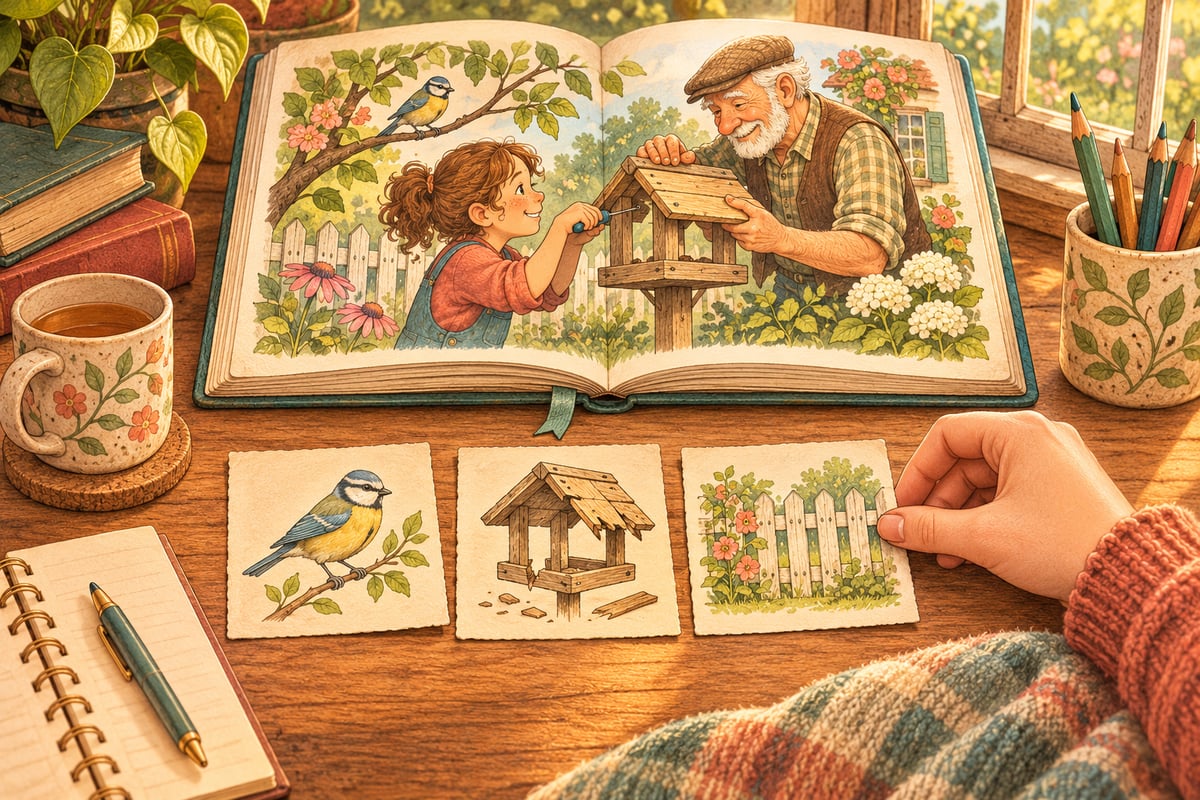
The first blank is what your character is trying to do. The second is why it matters to them. For example, a child wants to fix the garden bird feeder because the sparrows they watch before school have stopped coming. That reason gives you a clue about where the first scene could start. Maybe the child fills the feeder as usual, then watches the seeds spill straight onto the ground.
Find what gets in the way
Look through your notes for something that makes the goal harder to reach. That’s your source of conflict, the problem your character has to deal with before they can get what they want.
The obstacle might come from outside the character. The feeder has a split in its base, and the child can’t find a spare piece of wood. It might also come from within. The neighbor has a pile of scraps, but the child feels shy about asking for help. Either obstacle gives the child a decision to make.
If several problems could work, choose one and see what your character does about it. You can come back to the others after you’ve sketched a few scenes.
Decide what changes next
Give the character a choice, then ask what’s different because they made it? A choice can solve the problem, make it harder, or reveal something the character didn’t know.
Say the child asks the neighbor for a piece of wood. The neighbor offers to show them how to fix the feeder if they bring it over after school. Now the child has a way to repair it and a reason to go back. You have your next scene.
Try putting because or so between two notes. “The tape won’t hold, so the child asks the neighbor for a piece of wood” connects the failed repair to the decision to ask for help. If all you have is “and then,” look for the choice or discovery that could link the events.
Connect the notes you already have
Spread your notes out on paper or in a document. Look for a few that could play these roles.
- Character and goal. Who is trying to do something, and why does it matter to them?
- Obstacle. What makes getting it harder?
- Choice and change. What does the character do, and what happens as a result?
A note can fit in more than one place. The neighbor might be part of the obstacle if the child feels shy about asking. The neighbor can also help bring about the change by showing the child how to make a new base. Move notes around as you find connections. Keep ideas you haven’t used somewhere you can find them later.
Turn the chain into a few scenes
A scene is a moment the reader can follow as it happens, like the child knocking on the neighbor’s door and asking for help. Write one sentence for each moment you want to show. Here’s how the bird feeder notes might become four scenes.
- Before school, the child fills the feeder and sees the seeds fall through a crack.
- They try to patch the crack with tape, but it peels off as soon as they refill the feeder.
- They knock on the neighbor’s door to ask for wood, and the neighbor offers to teach them how to make a new base.
- They repair the feeder together, and the child invites the neighbor to watch for sparrows the next morning.
Use whatever words come easily, including another language if that helps you get the idea down. If a sentence feels hard to connect, ask what the character knows, wants, or can do afterward. You might find that two moments belong in the same scene or that one needs a clearer consequence. When you have a few scenes that follow each other, try grouping them into a chapter. If you want a bigger shape for the story, read The Simplest Story Structure That Actually Works.
Try it with three notes
Pick a character, an obstacle, and one detail you’d like to use. See if you can fit them into these three lines.
My character wants to ______ because ______.
When ______ gets in the way, they decide to ______.
Because they do that, ______ changes.
Use the last line to sketch your next scene. If you’d like help carrying those choices into an outline and editable chapters, you can develop the story in Storiando.